Search This Blog

Showing posts with label rate. Show all posts

Tuesday, August 26, 2014

IACC Statement Regarding Scientific, Practice and Policy Implications of Changes in the Diagnostic Criteria for Autism Spectrum Disorder

The DSM-5 criteria were published in May 2013.1, 2 Although the DSM-5 diagnostic criteria are intended primarily for use by clinicians and researchers in their diagnostic assessments, the IACC is aware that it is important to also remember that these the criteria also have a direct impact on people who have the disorders and their families, and their ability to assess symptoms and obtain services that can help them optimize their health, well-being and quality of life. Any revision of the diagnostic criteria must be made with great care so as to not have the unintended consequence of reducing critical services aimed at improving the ability of persons with autism. In this statement, the IACC describes a range of research, practice, and policy implications that arise as a result of the changes in theDSM criteria which deserve consideration as the DSM-5 is implemented in research, clinical, and educational settings.
Changes in the DSM Criteria
Starting with the DSM-III in 1980, autism was categorized as a Pervasive Developmental Disorders (PDD). In an effort to reflect what has been learned through research and practice since that time, the DSM-5 released in 2013 removed the PDD category and the accompanying subtypes (Autistic Disorder, Asperger Disorder, Childhood Disintegrative Disorder and Pervasive Developmental Disorder – Not Otherwise Specified) with a single disorder, Autism Spectrum Disorder (ASD). The DSM-5 criteria place greater emphasis on the two core symptom domains of ASD (social communication and restrictive, repetitive behaviors), and no longer consider verbal abilities as a diagnostic feature. Other changes included adding ratings of the severity of the two symptom domains and several clinical specifiers. These specifiers provide information about etiology, co-morbidities (e.g., intellectual disability, language delay, and medical conditions such as seizures), and pattern of onset.
Since ASD continues to be defined by a pattern of developmental and behavioral symptoms, changes to the diagnostic criteria come with potential trade-offs. One goal of the recent revisions was to improve specificity of the ASD diagnosis, reducing the number of false positive cases. However, concerns exist that this increased specificity may have gone too far in reducing the sensitivity of the ASD diagnosis, increasing the number of false negative cases. For example, removing a specific age cut-off for diagnosis was intended to improve the sensitivity of theDSM-IV criteria (which had required symptom onset by 3 years of age). By DSM-5's more inclusive criterion, "Symptoms must be present in the early developmental period but may not become fully manifest until social demands exceed limited capacities, or may be masked by learned strategies in later life" may reduce diagnostic specificity by expanding the list of differential diagnoses that must be considered. The inclusion of historical information also may have unintended consequences on sensitivity and specificity.
Another major change in DSM-5 was the addition of a new diagnosis category, Social Communication Disorder (SCD)which applies to individuals who exhibit persistent difficulty with the social use of verbal and nonverbal communication that cannot be explained by low cognitive ability. The symptoms of SCD have significant overlap with those of the ASD social communication domain, but the two disorders are considered to be unique and separate from each other. The distinction is clarified in the DSM-5 criteria, which note that ASD must be ruled out before a diagnosis of SCD can be considered. However, there is limited published information on SCD with a research basis primarily in the condition previously studied as Pragmatic Language Disorder (PLD). While SCD includes PLD, there is much to learn about the definition, measurement, scope, reliability, and validity of SCD as a diagnosed condition.

1 in 68 Children Now Has a Diagnosis of Autism Spectrum Disorder. Why?

The staggering increase in cases of ASD should raise more suspicion in the medical community about its misdiagnosis and overdiagnosis than it does. Promoting early screening for autism is imperative. But, is it possible that the younger in age a child is when professionals screen for ASD—especially its milder cases—the greater the risk that a slow-to-mature child will be misperceived as autistic, thus driving the numbers up?

Saturday, August 23, 2014

Summary of Advances in Autism Spectrum Disorder Research: Calendar Year 2013

Each year, the IACC releases its annual list of scientific advances that represent significant progress in the field. The 20 studies selected have given new insight into the complex causes of autism and potential risk factors, studied clues that could lead to earlier diagnosis, and evaluated promising early intervention strategies. 

The advances also address the prevalence of ASD both in the United States and internationally, as well as the service needs of people with ASD across the lifespan. The 2013 Summary of Advances provides short, plain language synopses of the top research breakthroughs selected by the IACC from a pool of peer-reviewed articles nominated by the members. Articles are grouped according to the questions of the IACC Strategic Plan for ASD Research. 

Printer Friendly Version

How to Think About the Risk of Autism


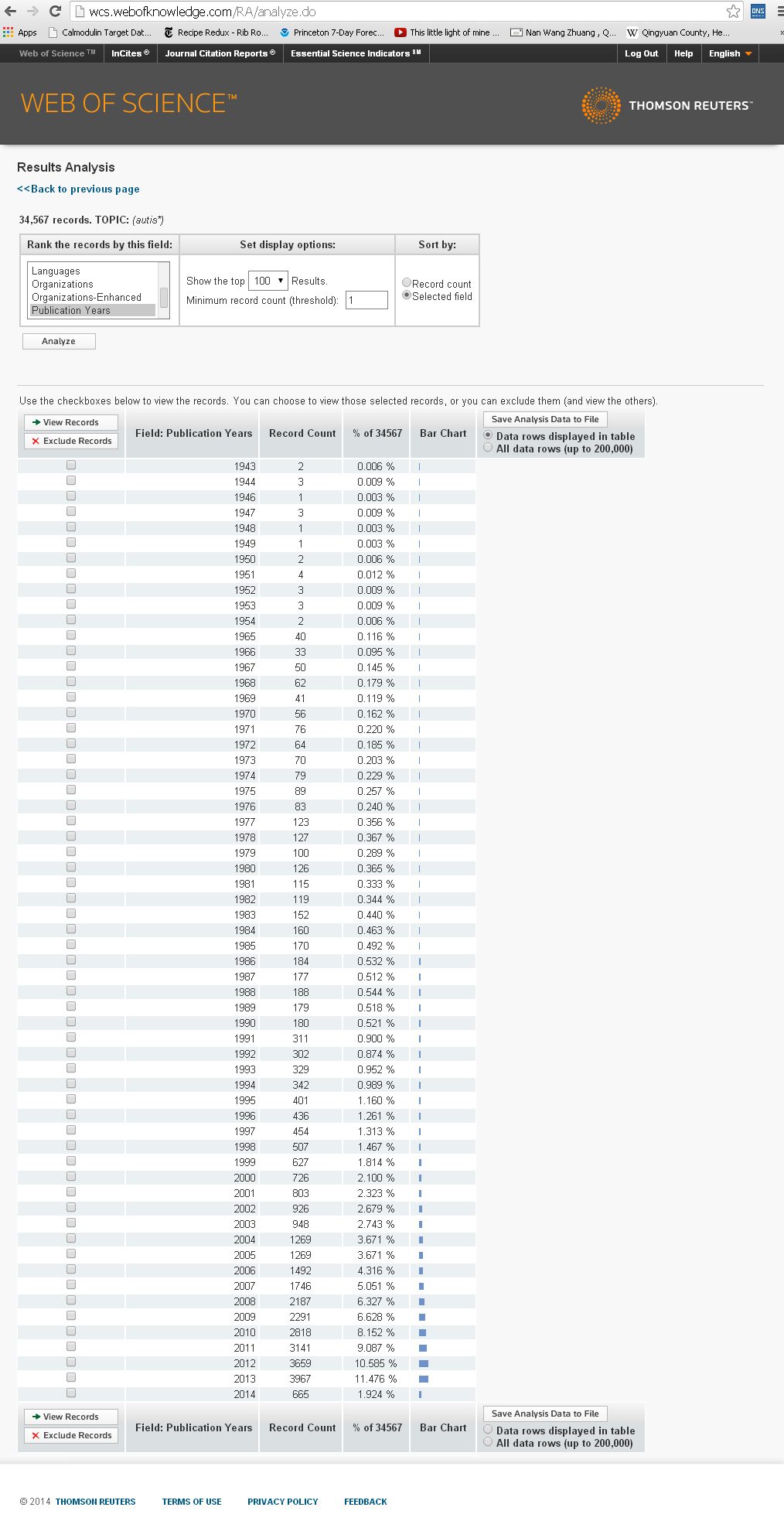
Over the last few years, we’ve seen an explosion of studies linking autism to a wide variety of genetic and environmental factors. Putting these studies in perspective is an enormous challenge. In a database search of more than 34,000scientific publications mentioning autism since its first description in 1943, over half have come since 2008.
As a statistically minded neuroscientist, I suggest a different approach that relies on a concept we are familiar with: relative odds. As a single common measuring stick to compare odds, I have chosen the “risk ratio,” a measure that allows the bigger picture to come into focus.
For a variety of studies I asked the same question: How large is the increased risk for autism? My standard for comparison was the likelihood in the general population of autism spectrum disorder. Here’s an example. Start from the fact that the recorded rate of autism is now 1 in 68, according to a report released last week by the Centers for Disease Control and Prevention. If babies born in purple farmhouses have a rate of autism of 2 in 68, this doubling means that the purple farmhouse carries a risk ratio of 2. However, correlation is not causation, and there is no need to repaint that farmhouse just yet.
Read more here. 

Wednesday, August 20, 2014

Race, Ethnicity May Influence Odds Of Regressive Autism

Children with autism from certain backgrounds are more likely to develop typically before suddenly losing critical skills like speech and the ability to make eye contact, researchers say.

The phenomenon known as developmental regression is twice as common in black children and occurs 50 percent more often in Hispanics as compared to white children.

Read more here.

Friday, August 1, 2014

Children of parents in technical jobs at higher risk for autism

Fathers who worked in engineering were two times as likely to have a child with an autism spectrum disorder (ASD). Those who worked in finance were four times more likely and those who worked in health care occupations were six times more likely to have a child on the autism spectrum.

There was no association with a mother’s occupation. However, children who had both parents in technical fields were at a higher risk of having a more severe form of autism.

“Parental occupation could be indicative of autistic-like behaviors and preferences and serve as another factor in a clinician’s diagnosis of a child with suspected autism. Medical students can be taught that this is one of the things to consider,” Dickerson said.

Read more here.

Newly Identified Students with Autism - 2009-2013


Data Notes:


1. "Newly Identified" means students who were identified in the state of Montana with a disability of autism in the 12 months since the last IDEA Child Count and who had not previously been identified with any disability (initial identification under IDEA.) This number does not include students from out-of-state who transferred into Montana with an established disability of autism under IDEA nor does it include students who were previously identified as having a developmental delay who are identified as autistic at age 6.

2. For example, in 2011 of the newly identified students with autism, 23% were six years of age.

3. By year; the number of newly identified students with autism, the total number of students with autism and the percentage of the students with autism in that child count year who were newly identified with autism in the 12 months since the previous child count.


2009 = 138/605 21%
2010 = 198/747 27%

2011 = 175/823 21%

2012 = 196/950 21%

2013 = 202/1052 19%

For the above years, the average percentage of newly identified students with autism was 22%

State laws for autism coverage are uneven across U.S.


In states such as Alabama, Idaho and North Dakota, which lack the mandates, families are forced to rely on Medicaid, a government-funded healthcare program that is facing budget cuts, or school services, which often don’t provide behavioral therapy.
These states tend to have a lower prevalence of children diagnosed with autism, about 4.2 per 100 children, compared with states that have passed mandates. Because the prevalence of autism should be about the same nationwide, the researchers suggest that these states are under-diagnosing children because of poor infrastructure.

Read more here.